
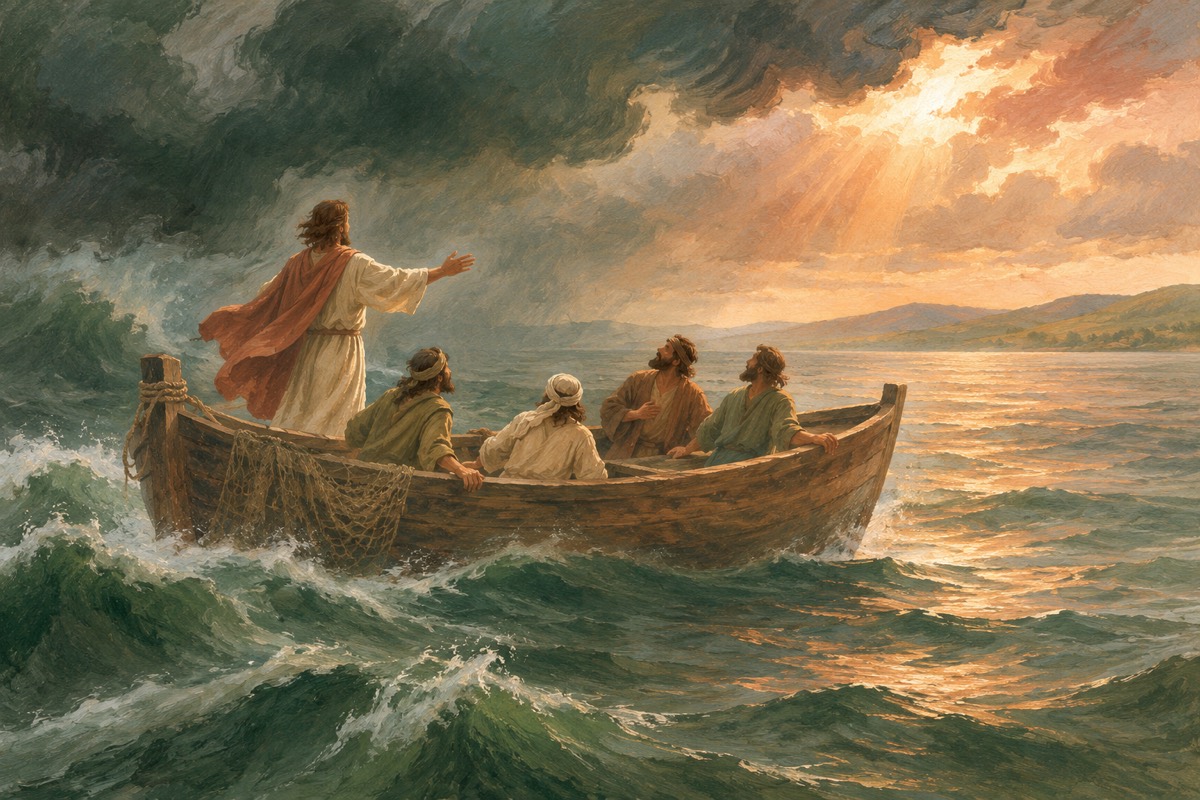
The storm in Mark 4 begins during a journey Jesus has asked his disciples to make. That detail matters. The story does not begin with people choosing a foolish route and discovering that they should have known better. It begins with an invitation to cross the water, followed by real danger. Read the passage slowly before deciding what lesson you expect it to teach.
Verses 35–38: take the danger seriously
The wind and waves threaten the boat while Jesus sleeps at the stern. The disciples wake him with a question that joins fear with concern about whether he cares. Mark gives us both the danger around them and the question arising within them. Their fear is not described in an empty setting; water is coming into the boat.
As an application, this helps us resist the habit of judging another person's fear from a distance. Before offering a quick spiritual answer, listen to what the person is facing. In our own prayers, we can name the situation plainly. ‘I am afraid, and I need your help’ is an honest place to begin.
Verses 39–40: notice the two directions of Jesus' words
Jesus addresses the wind and sea, and the storm becomes calm. He then addresses the disciples about their fear and faith. The story invites attention both to his authority over the danger and to the disciples' relationship with him. Its focus is larger than a technique for making an uncomfortable feeling disappear.
We should be careful about turning this event into a timetable for our own circumstances. Mark describes what Jesus did in this particular crossing. Our reflection can grow from that account without promising that every difficulty will end immediately when someone prays. Faith can include continuing to ask for help while taking the responsible steps a situation requires.
Verse 41: stay with the final question
After the calm, the disciples are still filled with awe and ask who Jesus is, since the wind and sea obey him. The story closes by directing our attention towards his identity. It asks more of us than admiring a dramatic rescue; it invites us to consider the one at the centre of it.
Try reading the passage again with that final question in mind. What do the disciples learn about Jesus that they did not fully grasp at the beginning? Then bring your own uncertainty into prayer. Ask for wisdom, companionship and courage for the next faithful action. If you are studying with others, allow each person to name a different detail. Careful listening can help a familiar story become a deeper encounter with the text.
REFLECT & RESPOND
Make room to listen.
- What does the disciples' question reveal about their fear?
- Why does the story end with a question about Jesus' identity?
- How can I offer practical care to someone who is in a difficult situation?
One step today
Read Mark 4:35–41 aloud. Note one detail you had overlooked, then turn it into a short, honest prayer.
A PRAYER TO MAKE YOUR OWN
Bring it before God.
Jesus, help me know you more deeply through your Word. Receive the fears I struggle to express. Give me wisdom for the next step, humility to receive support and courage to care for others. Teach me to trust you while I wait for what I cannot yet see. Amen.
Scripture & further reading
This is an original devotional reflection from Upper Room Daily. Scripture references link to the Bible passage; the reflections and applications are our commentary, not quotations from the Bible.
Read Mark 4:35–41 on Bible Gateway ↗Have a question or noticed something that needs correcting? Contact the ministry.
CONTINUE IN PRAYER
A moment to pray along.
Explore related prayers and Bible stories, then return to Scripture and consider one response you can practise.